You walk through the front door and immediately start forming an opinion. You like the kitchen. You're not sure about the flooring. The living room is bigger than it looked in the photos. And you

Dated: July 23 2026
Views: 271
One of the most common conversations we have with homeowners goes something like this: "Let's list it about 10% higher. Buyers are going to negotiate anyway."
Twenty years ago, that often made sense. Today's market is different.
In many price ranges, buyers don't see your asking price as the ceiling. They see it as the starting point.
When a home first comes on the market, buyers are asking themselves one question: "Is this home worth seeing?"
They aren't comparing your asking price to what they hope to pay after negotiating. They're comparing your home to every other home currently available.
If your home appears noticeably more expensive than similar properties, many buyers simply move on to the next listing. You may never get the chance to negotiate because they never schedule a showing.
Imagine your home's market value is $500,000. If you list it at $550,000 because you expect buyers to negotiate, you've already priced yourself 10% above where buyers believe the home belongs.
Meanwhile, another similar home enters the market at $500,000. It attracts strong interest. Multiple buyers compete. The final sale price climbs to $540,000.
The seller who "left room to negotiate" may still be waiting for an offer while the seller who priced competitively sells for nearly the same amount (which is actually higher than the amount that Seller 1 expected to get offered).
It feels backwards, but that's exactly how buyer competition works.
One of the biggest misconceptions in real estate is that sellers create value by asking more. In reality, buyers determine value.
When several buyers believe a home is well priced, they compete with one another. Competition often pushes the final sale price higher than the asking price. When buyers believe a home is overpriced, there is no competition. Without competition, there is little reason for buyers to improve their offers.
Over the years, real estate professionals have noticed a consistent pattern:
The market begins talking almost immediately.
The challenge is listening.
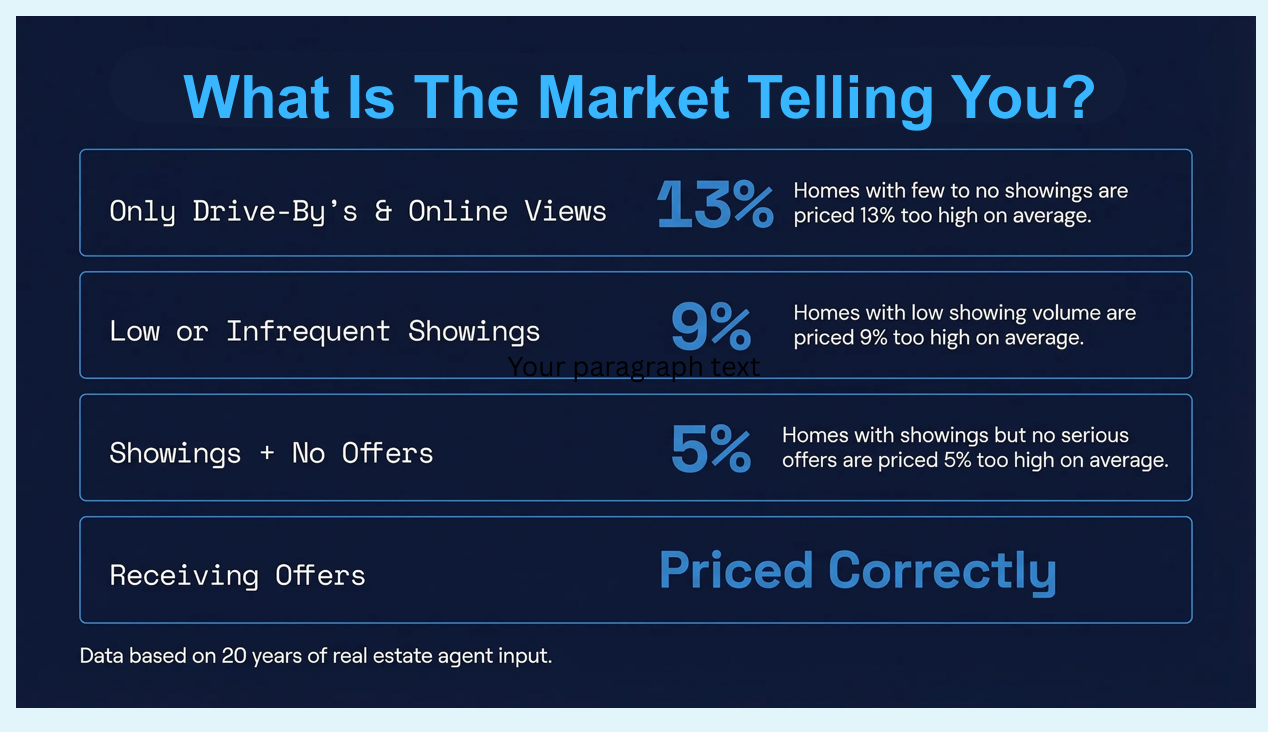
The first days after your home hits the market are usually when buyer interest is at its highest. Every serious buyer who has been waiting for a home like yours receives an alert. If they decide your home is overpriced, they may never come back.
Even after a price reduction, buyers often wonder: "Why hasn't it sold?" A home rarely gets a second "first week."
At RE/MAX Liberty, we don't think of pricing as trying to get the highest possible number on paper. We think of it as positioning.
The goal is to place your home where the greatest number of qualified buyers recognize its value. Sometimes that leads to one offer. Sometimes it leads to multiple offers. Sometimes buyers compete with one another and the final sale price exceeds the asking price.
Ironically, the best way to maximize your selling price isn't always to start with the highest asking price. It's to start with the right one.
If you're interested in a true market analysis, please reach out.


Buying or selling a home can feel overwhelming. My job is to make sure it doesn't have to. I work behind the scenes on nearly every transaction at REMAX Liberty, helping coordinate marketing, paperwo....
You walk through the front door and immediately start forming an opinion. You like the kitchen. You're not sure about the flooring. The living room is bigger than it looked in the photos. And you
You've spent months trying to buy a home. You got pre-approved. You searched. You toured homes. You finally found the right one. You put your offer in, and endured an agonizing day (or three) until
You bought your home. Now what? A Post-Closing Checklist for new homeownersTLDR? See our printable checklist at the bottom of the page.You made it. The offer was accepted. The inspection is over.
Winter in Central Massachusetts has a way of finding the weak spots in a house. A small draft becomes much more noticeable when temperatures drop. A clogged gutter can contribute to ice problems. A
 Massachusetts MLS Property Info Network (MLSPIN) - The property listing data and information set forth herein were provided to MLS Property Information Network, Inc. from third party sources, including sellers, lessors and public records, and were compiled by MLS Property Information Network, Inc. The property listing data and information are for the personal, non commercial use of consumers having a good faith interest in purchasing or leasing listed properties of the type displayed to them and
may not be used for any purpose other than to identify prospective properties which such consumers may have a good faith interest in purchasing or leasing. MLS Property Information Network, Inc. and its subscribers disclaim any and all representations and warranties as to the accuracy of the property listing data and information set forth herein. Last Update: September 22, 2026 5:24 PM UTC
Show More...
Massachusetts MLS Property Info Network (MLSPIN) - The property listing data and information set forth herein were provided to MLS Property Information Network, Inc. from third party sources, including sellers, lessors and public records, and were compiled by MLS Property Information Network, Inc. The property listing data and information are for the personal, non commercial use of consumers having a good faith interest in purchasing or leasing listed properties of the type displayed to them and
may not be used for any purpose other than to identify prospective properties which such consumers may have a good faith interest in purchasing or leasing. MLS Property Information Network, Inc. and its subscribers disclaim any and all representations and warranties as to the accuracy of the property listing data and information set forth herein. Last Update: September 22, 2026 5:24 PM UTC
Show More...
